
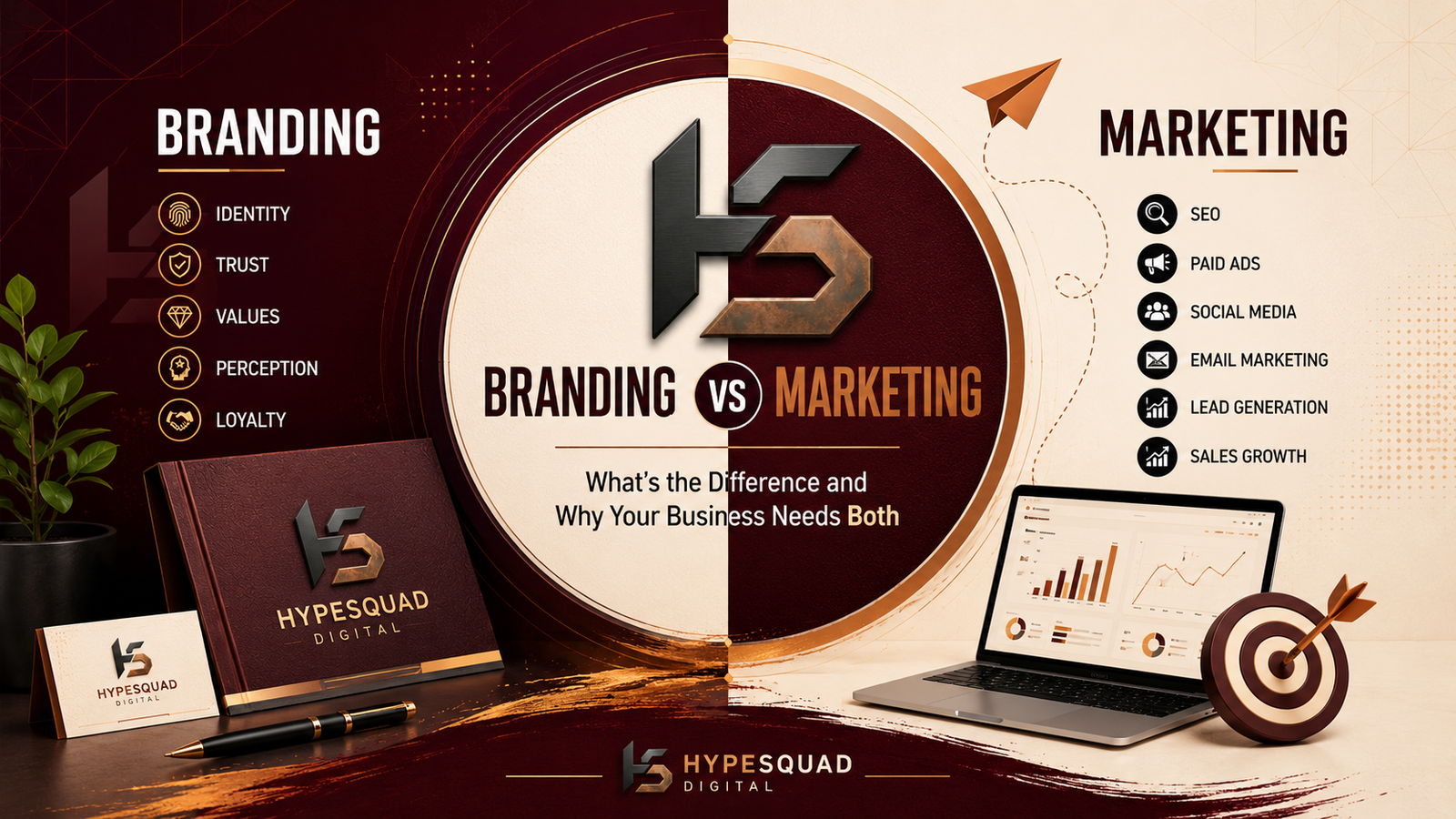

Branding vs Marketing is one of the most commonly misunderstood topics in business growth. Many business owners use the terms interchangeably, even though they serve different purposes.
Branding vs Marketing is one of the most commonly misunderstood topics in business growth. Many business owners use the terms interchangeably. While they are closely connected, they are not the same thing.
In fact, one of the biggest reasons businesses struggle to build long-term growth is because they invest heavily in marketing without establishing a strong brand foundation first.
You can run advertisements, create social media campaigns, and invest in SEO, but if customers don’t trust, remember, or connect with your business, marketing efforts become less effective over time.
On the other hand, even the strongest brand won’t grow if nobody knows it exists.
This is why successful businesses understand the relationship between branding and marketing. Branding creates the identity and perception of a business, while marketing communicates that identity to the world.
In this guide, we’ll explore the key differences between branding and marketing, how they work together, and why every business needs both to achieve sustainable growth.
What Is Branding?
Branding is the process of creating a unique identity, personality, and perception for your business.
It defines how people think and feel about your company.
Your brand is not just your logo, colors, or website design. It’s the complete experience customers associate with your business.
Branding answers questions such as:
- Who are you as a business?
- What do you stand for?
- What makes you different?
- Why should customers trust you?
- What emotions should people associate with your brand?
A strong brand creates recognition, trust, and loyalty.
When people instantly recognize companies like Apple, Nike, or Coca-Cola, they’re responding to years of consistent branding efforts.
What Is Marketing?
Marketing is the process of promoting your products, services, and brand to attract potential customers and generate business growth.
Marketing focuses on reaching the right audience with the right message at the right time.
It includes activities such as:
- Search Engine Optimization (SEO)
- Social Media Marketing
- Google Ads
- Email Marketing
- Content Marketing
- Influencer Marketing
- Video Marketing
- Paid Advertising
Marketing answers questions such as:
- How will customers discover us?
- How can we generate leads?
- How do we increase sales?
- How do we attract our target audience?
While branding shapes perception, marketing drives visibility and action.
Branding vs Marketing: Understanding the Core Difference
A simple way to understand the difference is:
Branding is who you are. Marketing is how you promote who you are.
Branding creates the foundation.
Marketing amplifies that foundation.
Think of branding as your reputation and marketing as your communication strategy.
Without branding, marketing lacks direction.
Without marketing, branding lacks visibility.
Branding vs Marketing: Side-by-Side Comparison
Understanding Branding vs Marketing becomes much easier when comparing their roles side by side.
| Branding | Marketing |
|---|---|
| Focuses on identity | Focuses on promotion |
| Builds trust and loyalty | Generates leads and sales |
| Long-term strategy | Short and long-term campaigns |
| Creates emotional connection | Encourages action |
| Defines company values | Drives traffic and awareness |
| Shapes customer perception | Targets specific audiences |
| Remains relatively consistent | Adapts based on goals and trends |
Branding influences how people feel.
Marketing influences what people do.
Why Branding Comes Before Marketing
Businesses that invest in a strong brand foundation often see better results from their marketing efforts.
Imagine spending thousands of dollars on advertising without a clear brand identity.
Potential customers may see your ads, visit your website, and even engage with your content.
But if your messaging is inconsistent or your business doesn’t stand out from competitors, those marketing efforts won’t deliver maximum results.
Strong branding provides:
- Clear messaging
- Consistent communication
- Customer trust
- Market differentiation
- Higher perceived value
When branding is established first, marketing becomes significantly more effective.
The Key Components of Branding
1. Brand Purpose
Your purpose explains why your business exists beyond making money.
Customers increasingly support brands that align with their values.
2. Brand Positioning
Positioning defines how your business is perceived compared to competitors.
It answers the question:
“Why should customers choose us?”
3. Brand Messaging
Messaging includes:
- Mission statement
- Value proposition
- Brand voice
- Taglines
- Communication style
Strong messaging creates clarity and consistency.
4. Visual Identity
Visual branding includes:
- Logo design
- Typography
- Brand colors
- Website design
- Social media visuals
Visual consistency improves recognition and trust.
5. Customer Experience
Every interaction contributes to branding.
This includes:
- Customer support
- Website usability
- Product quality
- Sales process
- After-sales service
Great experiences strengthen brand perception.
The Key Components of Marketing
1. Search Engine Optimization (SEO)
SEO helps businesses attract organic traffic through search engines.
Google’s Search Central documentation provides valuable guidance for creating high-quality content and improving search visibility.
2. Content Marketing
Blogs, videos, guides, and case studies educate audiences and build authority.
3. Social Media Marketing
Social platforms help businesses engage with customers and increase visibility.
4. Paid Advertising
Advertising accelerates reach and lead generation.
Examples include:
- Google Ads
- Facebook Ads
- Instagram Ads
- LinkedIn Ads
5. Email Marketing
Email marketing nurtures leads and strengthens customer relationships.
6. Marketing Automation
Automation helps businesses scale communication and improve efficiency.
How Branding and Marketing Work Together
Branding and marketing should never operate independently.
The strongest businesses integrate both into a unified growth strategy.
Here’s how they work together:
Branding Creates Trust
Customers are more likely to buy from brands they recognize and trust.
Marketing Creates Awareness
Marketing ensures people discover your brand.
Branding Increases Conversion Rates
A trusted brand converts more effectively than an unknown competitor.
Marketing Generates Opportunities
Marketing creates the opportunities that branding helps convert.
Together, they create a powerful growth engine.
Real-World Example
Imagine two digital marketing agencies offering similar services.
Agency A
- Professional website
- Clear messaging
- Strong brand identity
- Consistent visual design
- Positive customer reputation
Agency B
- Generic website
- Inconsistent messaging
- No unique positioning
- Weak brand presence
Both agencies run identical advertising campaigns.
Which one is more likely to generate leads and close sales?
Agency A.
Why?
Because branding increases trust before the marketing campaign even begins.
Common Mistakes Businesses Make
Focusing Only on Marketing
Many businesses invest heavily in advertising without building a recognizable brand.
This often leads to higher acquisition costs and lower customer loyalty.
Focusing Only on Branding
Some businesses spend months perfecting logos and visuals but fail to promote themselves effectively.
A great brand still needs visibility.
Inconsistent Messaging
Customers become confused when businesses communicate different messages across different channels.
Consistency is essential.
Ignoring Customer Experience
Branding doesn’t stop at design.
Poor customer experiences can damage even the strongest brand.
Which Is More Important: Branding or Marketing?
The Branding vs Marketing debate often leads businesses to focus too heavily on one area while neglecting the other.
This is one of the most common questions businesses ask.
The truth is:
Neither is more important.
Branding and marketing serve different purposes.
Branding creates the foundation.
Marketing drives growth.
Businesses that prioritize both tend to achieve:
- Stronger customer loyalty
- Higher conversion rates
- Better brand recognition
- Improved marketing ROI
- Sustainable long-term growth
The most successful companies don’t choose between branding and marketing.
They invest in both.
How to Build a Balanced Growth Strategy
To achieve sustainable growth:
Step 1: Develop Your Brand Foundation
Define:
- Mission
- Vision
- Values
- Positioning
- Brand voice
Step 2: Create Consistent Visual Branding
Ensure consistency across:
- Website
- Social media
- Marketing materials
- Advertising campaigns
Step 3: Implement Strategic Marketing
Invest in:
- SEO
- Content Marketing
- Social Media Marketing
- Paid Advertising
- Email Marketing
Step 4: Measure and Optimize
Track performance and continuously improve both branding and marketing efforts.
Branding and Marketing as Part of a Digital Growth System
Businesses that achieve sustainable growth rarely rely on isolated marketing activities.
Branding and marketing work best when integrated into a complete Digital Growth System that connects strategy, websites, SEO, content, lead generation, automation, and analytics.
Instead, they build a connected system where branding, websites, SEO, content, lead generation, automation, and analytics work together.
Branding creates trust.
Marketing creates visibility.
Together, they become key components of a larger Digital Growth System that supports long-term business growth.
How HypeSquad Digital Helps Businesses Build Strong Brands and Marketing Systems
At HypeSquad Digital, we help businesses align branding, websites, SEO, performance marketing, automation, and analytics into one connected growth system.
Rather than treating branding and marketing as separate functions, we create strategies that ensure every customer touchpoint supports visibility, trust, lead generation, and business growth.
Our goal is to help businesses build stronger foundations, smarter systems, and sustainable growth for the future.
Frequently Asked Questions
What is the difference between branding and marketing?
Branding defines how people perceive your business, while marketing promotes your products, services, and brand to attract customers.
Which comes first, branding or marketing?
Branding should come first because it creates the foundation that marketing communicates and amplifies.
Can a business succeed with marketing but without branding?
Marketing can generate short-term visibility, but strong branding is essential for long-term trust, loyalty, and sustainable growth.
Why are branding and marketing important for business growth?
Together, branding and marketing help businesses build recognition, attract customers, improve conversions, and create long-term growth.
Final Thoughts
Instead of thinking about Branding vs Marketing as a choice, businesses should view them as complementary growth drivers.
Branding and marketing are not competitors—they are partners.
Branding shapes how people perceive your business.
Marketing ensures people discover it.
Without branding, marketing lacks impact.
Without marketing, branding lacks reach.
The businesses that grow fastest are not necessarily the ones spending the most on advertising. They are the ones that combine a strong brand foundation with strategic marketing execution.
When branding and marketing work together, businesses build trust, attract the right audience, improve conversions, and create sustainable long-term growth.
If your goal is to build a business that stands out in a crowded market, don’t think in terms of branding versus marketing.
Think in terms of branding and marketing working together to drive growth.