
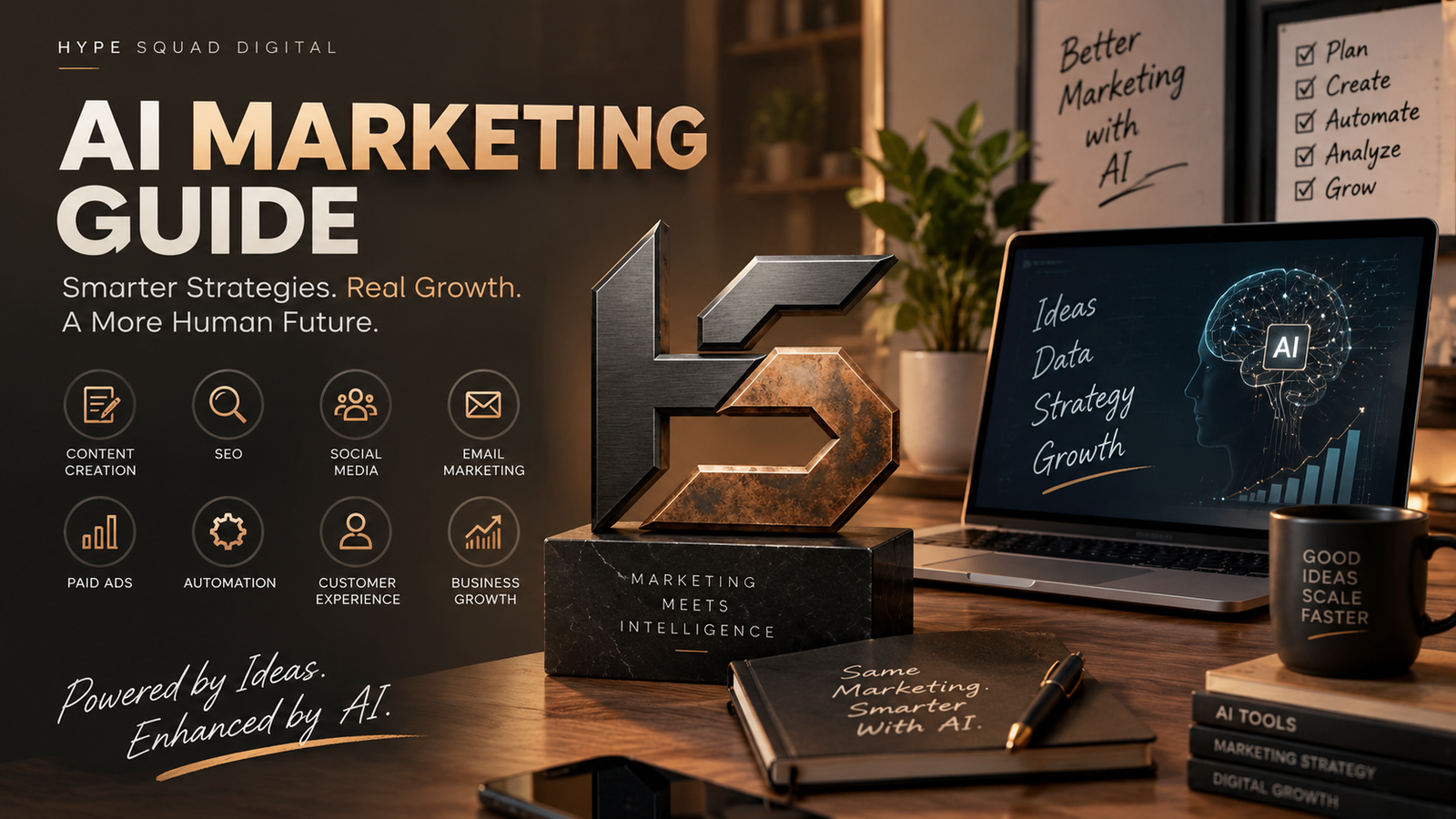

AI Marketing Guide: How to Use Artificial Intelligence for Smarter Marketing in 2026
AI Marketing Guide is becoming an important topic for businesses of every size. Artificial intelligence is changing how companies understand customers, create content, run advertising campaigns, analyze data, and improve customer experiences.
But AI marketing is not simply about asking an AI tool to write a social media post or generate an advertisement. The real value comes from using AI to make better decisions, save time, understand customer behavior, and create more relevant experiences. AI Marketing Guide
For small businesses, startups, agencies, and established brands, AI can make marketing more efficient without removing the human side of the business.
In this AI Marketing Guide, we’ll explain what AI marketing is, how it works, where businesses can use it, its benefits and challenges, and how to create a practical AI marketing strategy.
Table of Contents
- What Is AI Marketing?
- How Does AI Marketing Work?
- Why Is AI Important for Marketing?
- Major Applications of AI in Marketing
- AI for Content Marketing
- AI for SEO
- AI for Social Media Marketing
- AI for Email Marketing
- AI for Paid Advertising
- AI for Customer Experience
- Benefits of AI Marketing
- Challenges of AI Marketing
- How to Create an AI Marketing Strategy
- AI Marketing Best Practices
- The Future of AI Marketing
- Frequently Asked Questions
- Conclusion
What Is AI Marketing?
AI marketing is the use of artificial intelligence technologies to improve marketing activities and decision-making.
Traditional marketing often depends heavily on manual research, campaign planning, content creation, audience analysis, and reporting. AI can assist marketers with many of these tasks by processing large amounts of information and identifying patterns much faster.
AI marketing can be used for:
- Content creation and ideation
- Customer data analysis
- Search engine optimization
- Social media planning
- Email personalization
- Advertising optimization
- Lead scoring
- Customer support
- Predictive analytics
- Marketing automation
The important point is that AI should support marketers rather than replace human judgment. AI Marketing Guide
A successful campaign still needs creativity, strategy, brand understanding, and a genuine connection with customers.
How Does AI Marketing Work?
AI marketing combines customer data, algorithms, automation, and machine learning to help businesses understand and respond to their audiences.
For example, an online store may notice that customers who view a particular product often purchase another related product. AI can identify this pattern and help the business create personalized product recommendations.
Similarly, an email marketing platform can analyze customer interactions and help determine which content or offers are more relevant to different groups of subscribers.
The process generally looks like this: AI Marketing Guide
Collect Data → Analyze Behavior → Identify Patterns → Personalize Marketing → Measure Results → Improve Campaigns
The more useful and accurate the available data is, the more effectively AI can support marketing decisions.
Why Is AI Important for Marketing?
Marketing teams have more data and more channels than ever before.
A business may need to manage:
- Google Search
- Websites
- Social media
- Email campaigns
- Online advertising
- Video content
- Customer reviews
- CRM data
- Analytics
Managing everything manually can take significant time.
AI can help marketers handle repetitive work and identify useful insights more quickly. This allows marketing professionals to spend more time on strategy, creative thinking, customer relationships, and business growth.
AI also makes personalization more practical.
Instead of treating every customer exactly the same, businesses can use customer behavior and preferences to create more relevant messages. AI Marketing Guide
Major Applications of AI in Marketing
AI can be applied throughout the marketing funnel, from attracting a potential customer to retaining an existing one.
Let’s look at some of the most useful applications.
1. AI for Content Marketing
Content marketing requires a continuous flow of ideas.
Businesses need blog posts, social media captions, newsletters, videos, landing pages, product descriptions, and other forms of content.
AI can help marketers:
- Generate content ideas
- Create outlines
- Research topics
- Improve headlines
- Repurpose existing content
- Create content variations
- Identify frequently asked questions
- Improve readability
However, there is an important difference between AI-assisted content and simply publishing automatically generated text.
Good content should provide real value.
AI can help with the first draft, but human review is important for accuracy, originality, brand voice, and customer relevance.
The best approach is simple: AI Marketing Guide
Let AI speed up the process, but let humans control the message.
2. AI for SEO
Search engine optimization is another area where AI can support marketers.
AI tools can help with:
- Keyword research
- Search intent analysis
- Content planning
- Topic clustering
- Content optimization
- Competitor research
- Internal linking ideas
- Content gap analysis
AI can also help businesses understand what questions customers are asking.
For example, instead of targeting only a broad keyword such as “digital marketing,” a business can create content around related questions such as:
- What is digital marketing?
- How does digital marketing work?
- How much does digital marketing cost?
- Which digital marketing strategy is best for small businesses?
This creates a more comprehensive content strategy.
However, AI should not be used to create large amounts of low-value content simply to target keywords. Search engines increasingly focus on useful content that genuinely satisfies users.
3. AI for Social Media Marketing
Social media marketing involves much more than posting regularly.
Businesses need to decide:
- What to post
- When to post
- Which format to use
- Which audience to target
- How to respond to engagement
- Which content performs best
AI can help organize this process.
For example, a marketing team can use AI to generate multiple content ideas around one campaign and then adapt them for different platforms.
A single blog post could become:
- An Instagram carousel
- A LinkedIn post
- A short video script
- A Facebook post
- A newsletter
- Several short social media captions
This process saves time while allowing businesses to maintain a consistent message across platforms.
Still, social media should feel human. Generic AI-generated posts can easily sound repetitive. AI Marketing Guide
4. AI for Email Marketing
Email marketing becomes more effective when messages are relevant to the recipient.
AI can assist with:
- Subject line ideas
- Audience segmentation
- Personalized recommendations
- Send-time optimization
- Campaign analysis
- Customer behavior prediction
- Email content variations
For example, an eCommerce business doesn’t have to send exactly the same email to every customer.
Someone who abandoned a shopping cart may need a reminder, while a long-term customer may respond better to a loyalty offer.
AI can help marketers create these different experiences at scale.
5. AI for Paid Advertising
Advertising platforms already use machine learning extensively to help businesses reach potential customers.
AI can assist marketers with:
- Audience analysis
- Ad variations
- Budget allocation
- Campaign optimization
- Conversion prediction
- Performance analysis
Instead of manually checking every campaign element, marketers can use AI-powered systems to identify patterns and optimize campaigns based on performance data.
But automation doesn’t mean marketers should stop monitoring campaigns.
Businesses should still review:
- Cost per lead
- Conversion rate
- Return on ad spend
- Customer acquisition cost
- Audience quality
The goal is not simply to get more clicks.
The goal is to generate meaningful business results. AI Marketing Guide
6. AI for Customer Experience
Customer experience can have a major impact on brand loyalty.
AI-powered chatbots and virtual assistants can help customers find information, answer common questions, and receive support outside traditional business hours.
AI can also help businesses understand customer feedback by analyzing:
- Reviews
- Surveys
- Support conversations
- Social media comments
- Customer messages
This can reveal recurring complaints and opportunities for improvement.
For example, if customers repeatedly ask the same question about a product, a business could improve its product page or create a dedicated FAQ section.
AI doesn’t just answer customers.
It can also help businesses understand what customers actually need.
Benefits of AI Marketing
There are several reasons businesses are adopting AI marketing strategies.
Saves Time
AI can automate repetitive tasks and reduce the amount of manual work involved in marketing.
Improves Personalization
Businesses can deliver more relevant content, recommendations, and offers based on customer behavior.
Supports Better Decisions
AI can process large amounts of data and identify patterns that may be difficult to notice manually.
Improves Productivity
Marketing teams can spend less time on repetitive tasks and more time on strategy and creativity.
Helps Scale Marketing
Small teams can produce and manage more marketing activities with the right AI-assisted workflow.
Enables Faster Testing
Businesses can test different headlines, messages, creative concepts, and campaign variations more efficiently.
Challenges of AI Marketing
AI marketing also comes with challenges.
1. Lack of Human Creativity
AI can generate content quickly, but it may not understand your brand, customers, culture, or business story as deeply as a human team.
2. Incorrect Information
AI systems can sometimes produce inaccurate or outdated information. Human fact-checking remains important.
3. Generic Content
If businesses rely too heavily on AI without adding original insights, their content can become repetitive.
4. Privacy Concerns
Businesses must handle customer data responsibly and follow applicable privacy requirements.
5. Over-Automation
Not every customer interaction should be automated.
Sometimes customers simply want to talk to a real person. AI Marketing Guide
How to Create an AI Marketing Strategy
You don’t need dozens of AI tools to begin.
A practical strategy can start with five steps.
Step 1: Define Your Goal
Decide what you want AI to improve.
For example:
- More leads
- Better content production
- Higher conversions
- Improved customer support
- Better advertising performance
Step 2: Identify Repetitive Tasks
Look at your current marketing workflow.
Which tasks consume the most time?
Those are often good candidates for AI assistance.
Step 3: Choose the Right Tools
Don’t select tools simply because they are popular.
Choose tools based on your actual requirements, budget, team skills, and existing marketing systems.
Step 4: Keep Humans in the Loop
Review AI-generated content, recommendations, and customer-facing communication before publishing or implementing them.
Step 5: Measure Results
Track whether AI is actually improving performance.
Monitor metrics such as:
- Conversion rate
- Website traffic
- Lead quality
- Customer acquisition cost
- Engagement
- Revenue
- Return on investment
If a tool saves time but doesn’t improve quality or results, reconsider how you’re using it.
AI Marketing Best Practices
To get better results from AI marketing, follow a few simple principles.
Start Small
Begin with one or two practical use cases instead of trying to automate your entire marketing department.
Protect Your Brand Voice
AI-generated content should sound like your business—not like every other company using the same tool.
Add Original Experience
Include your team’s insights, examples, case studies, opinions, and expertise.
Verify Important Information
Always fact-check statistics, claims, product information, and industry-specific information before publishing.
Focus on Customers
Technology should improve the customer experience, not simply make marketing faster.
Keep Testing
AI marketing is not a set-it-and-forget-it strategy. Continue testing different approaches and learn from the results.
What Is the Future of AI Marketing?
AI will continue to influence almost every part of digital marketing.
We can expect marketing workflows to become more automated and personalized, while AI-powered search and recommendation systems will influence how customers discover businesses.
The role of marketers will also change.
Instead of spending most of their time on repetitive production tasks, marketers may increasingly focus on:
- Strategy
- Brand positioning
- Creative direction
- Customer psychology
- Data interpretation
- Original storytelling
- Business decision-making
The businesses that benefit most from AI won’t necessarily be those using the most tools.
They will be the businesses that use AI thoughtfully while keeping human creativity, trust, and customer understanding at the center of their marketing.
Frequently Asked Questions
What is AI marketing?
AI marketing is the use of artificial intelligence to support marketing activities such as content creation, customer analysis, personalization, SEO, advertising, automation, and campaign optimization.
How can small businesses use AI marketing?
Small businesses can use AI for content ideas, social media planning, email personalization, customer support, SEO research, advertising analysis, and repetitive marketing tasks.
Will AI replace digital marketers?
AI is more likely to change marketing roles than completely replace marketers. Human creativity, strategy, judgment, communication, and customer understanding remain valuable.
Is AI-generated content good for SEO?
AI-generated content can be useful when it provides genuine value and is reviewed and improved by humans. Simply producing large amounts of generic content for search engines is not a strong SEO strategy.
What are the benefits of AI in marketing?
Major benefits include increased productivity, faster analysis, better personalization, marketing automation, improved efficiency, and the ability to scale certain marketing activities.
Conclusion
AI marketing is no longer just a futuristic idea. It is becoming part of everyday marketing workflows.
From content creation and SEO to social media, email campaigns, advertising, analytics, and customer support, artificial intelligence can help businesses work smarter and respond more effectively to customer needs.
Blogs
But technology alone doesn’t create successful marketing. AI Marketing Guide
The strongest results come from combining AI’s speed and analytical capabilities with human creativity, experience, empathy, and strategic thinking.
If you’re starting with AI marketing, don’t try to change everything at once. Choose one marketing problem, test an AI-assisted solution, measure the result, and improve your process over time.
Use AI to make your marketing smarter—not less human.